
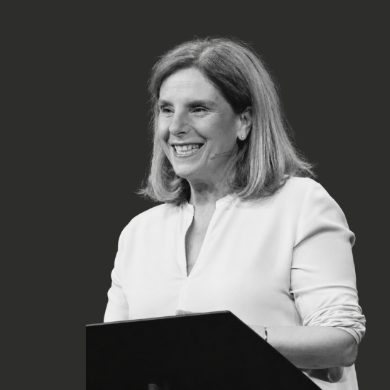
The topic of heat came to you while you were Athens’ Deputy Mayor for Urban Nature and Climate Resilience, working on the city’s Resilience Strategy as part of the 100 Resilient Cities1 programme. What did you see on the ground, in neighbourhoods, in hospitals, in people’s daily lives, that shows heat to be a public health emergency2?
Our first step in developing the Resilience Strategy was to go and talk to people, to understand what risks they felt they were facing. We talked to scientists and experts, as well as bus passengers, homeless people, cyclists, delivery people, different minorities, and each perspective was counted equally. The programme asked us to listen specifically to people who usually don’t have a voice.
This allowed us to draw a map of what people felt about the city: its weaknesses and challenges as people perceived them, as well as its strengths. And heat kept coming up as both a shock and a stress, but it was never central to the discussions. This work took place during the economic crisis in Greece, and energy was foremost in people’s minds. This led me to start focusing on the link between heat and buildings, and heat and nature. How we build and what we do about heat was not at all on the minds of the leadership at that time. That is why I asked to be appointed Deputy Mayor for Urban Nature and Urban Resilience. I wanted people to start thinking of nature as a solution for resilience.
Inequality is one of the most critical issues with heat, which has a way of being particularly inequitable.
In France, a famous TV presenter sparked controversy by claiming that we all experience heat the same way: a billionaire suffers from it just as much as someone living in a Paris attic room. The wealthy are affected too, of course, but let’s talk about the inequalities linked to this issue.
Inequality is one of the most critical issues with heat, which has a way of being particularly inequitable. I often describe heat as a ghost that goes through the city, through our built and unbuilt environment, and finds those who are the poorest, the sickest, the youngest, the oldest, the ones who don’t have support.
Heat brings out the socioeconomic, racial or ethnic gaps in our societies. It makes visible those whom public policies have left behind, which immediately confronts politicians with their inaction.
Part of dealing with heat obviously depends on political will, but there also seems to be an issue of awareness. Many of us are not equipped to recognise what is happening or how dangerous it is. Just as we distinguish a storm from a hurricane, we need to tell warm weather from a heatwave. Seville, for example, has started naming heatwaves. How can we build a framework of understanding for the general public?
In Athens, similarly to Seville, we created categories of heatwaves. We created an algorithm specific to the city of Athens that brought together temperature, atmospheric pressure, humidity, climate data, seasonal data, backcasting and forecasting, mortality rate… The resulting levels were colour-coded yellow, orange or red. And of course this had to be linked to a specific message, because the impact of heatwaves on public health is not widely recognised.
This is a second critical issue for me: making sure the public understands the danger.
Heat can suddenly affect you in ways you don’t expect, because you think you’re used to it, especially in Mediterranean countries. People don’t really understand that, after a point, the body really starts to crash because of heat. And the same is true in countries that are not used to heat, where people are just happy that it is finally hot.
This is a second critical issue for me: making sure the public understands the danger. Even though people hear that it’s dangerous, they never feel it is going to affect them personally. However, thermal safety is becoming a public policy issue par excellence, which is something I’m also fighting for, as both politicians and the public have not been taking it seriously into account. It’s also because politicians have not made people understand that this falls under their purview. When it’s hot, people don’t understand that politicians can do things, and that they should be asking their politicians to do things.
How can participatory processes and citizen involvement improve the way heat is understood and policies are designed?
I’m a big proponent of participatory policies, because I believe that informing somebody and changing their behaviour are not necessarily the same thing. Unless you get people involved, so that they feel it’s their issue too, it’s hard to get them to change their behaviour. The more you engage people by designing things together with them, the more they feel ownership.
Our political representatives often don’t feel at ease with participatory processes, while the public increasingly expresses a need for them. I think that’s an interesting shift over the last few decades.
In theory, we know what is needed: green and blue infrastructure, shade, and healthcare measures, such as adapting hospital admissions during emergencies. Yet these issues still seem absent from public policy, or at least not tackled at the root. How do you explain this?
Central governments have to understand that this is a new modus operandi, a new kind of condition within which we have to function. We also need to create the capacity in countries to understand that heat has to be dealt with at a centralised and integrated level. This is what I am trying to co-design with countries in my role at the United Nations Environment Programme.
Globally we have policies that deal with cooling, usually in relation to energy, and ones that deal with heat, which usually focus on health, and the two are totally uncoordinated even though in practice they coincide. That’s part of what we’re trying to do with the Global Roadmap on Heat Resilience and Sustainable Cooling: to co-design ways that bring the heat and cooling communities and agendas together. The Roadmap focuses on two outcomes: first, how can we keep people safe, and second, how can we keep critical systems working when heat rises. Of course we need to make sure that our solutions are sustainable, so that we don’t make things worse.
We cannot continue going from heatwave to heatwave, as if it were an event to prepare for. It’s not an event anymore.
Heat is at a different level of urgency than other impacts of climate change. The levels of mortality are the greatest compared to anything else, because of the injustice, and because heat creates conditions that make our societies and our economies show their weaknesses more than ever before. The idea of democracy is this social contract, where we give the government the power to do things that help us survive, keep our societies healthy, and keep our economies running. This is especially true in Europe and in France, if we still want to call ourselves “socially conscious” societies.
I would like to turn to the controversy over air conditioning. France is one of the least air-conditioned countries with a Mediterranean coastline, and the issue has become a political battle: some call for air conditioning for all, others only for the most vulnerable and public institutions.
I have always argued that we can’t air condition ourselves out of this. Of course we need it for the most vulnerable, for hospitals or social services, because it saves lives. But it’s not a panacea.
We have created a hierarchy of solutions3 that starts with keeping cities cool in general. This means passive cooling solutions first: nature-based, how we design and orient buildings, ventilation, shading, insulation. Then, we have to think of fans and other low-energy solutions. These solutions, unlike air conditioning, don’t heat up public space. Then come mixed solutions: keeping the air conditioning low and the fan running. Only after that comes air conditioning, and even then we should opt for solutions with the lowest possible emissions (energy mix and pollutants).
What about people who work outside: construction workers, delivery riders, farmers?
Exactly, what are you going to do with them? There’s no air conditioning there. There have to be guidelines from the Ministry of Labour that set, for each industry, specific rules on when, how and under which conditions people should work. A lot of countries have already started working on it, including France4.
It’s interesting, because it’s only in the last three or four years that countries have been stepping up and doing this for the workforce. They’re starting to understand that they have to put these guidelines into effect.
The role of the Chief Heat Officer is very recent. In France, this position is linked to electoral mandates at the municipal level. How would you describe the role, and how do you ensure continuity in the work?
A Chief Heat Officer is somebody who helps coordinate, internally and externally, the work that needs to be done in cities. They talk to the different departments and try to make sure one department isn’t counteracting the efforts of another, which is often the case. You cannot just go around giving air conditioning to everybody, pedestrianising everything or putting a million trees in the city. You have to have a good plan with the right kind of measurable effects.
Can you share some concrete results showing the benefits of appointing a competent person to this role?
In most cases, chief heat officers only started a couple of years ago, around 2022. What they mostly had to do was draw up heat action plans and start putting things in place, so we don’t really have clear measurements yet, apart from independent reviews by journals or researchers.
If you were advising a European city, what two or three things would you tell it to implement in the next twelve months to prevent, adapt to or mitigate the next heatwave?
First of all, I would ask them not to think of “the next heatwave next summer”, but of a new condition we will be operating in, which will be hotter. We know we are going to overshoot 1.5 degrees Celsius, the Paris Agreement target. And we know that every tenth of a degree matters, because each one creates conditions, especially in cities, where it is more and more difficult and expensive to keep people safe and to keep livelihoods and jobs possible.
So the first thing I would ask cities is to understand that this is long term, and that they have to coordinate their different departments to deal with it. Start creating scenarios for 2070, 2080, 2100. These scenarios have to look at foresight data, not back data. Governments really have to start looking into the future and building now the kind of infrastructure and buildings that will be resilient for the temperatures and conditions we will have in those decades. This is super important. So that’s the first thing: not going from heatwave to heatwave, as if it were an event to prepare for. It’s not an event anymore.
Then, there are two sectors that I believe are the most important to think about. First, we have to bring more nature into our cities. Of course, it will never create conditions that are safe during peak shock periods of extreme heat, but it will keep the overall temperatures of the city lower. The new EU law, the Nature Restoration Regulation, is something we should use for that.
The second is about education and public knowledge. The role of media is very important for that.
- The 100 Resilient Cities programme is a worldwide city network pioneered by the Rockefeller Foundation to help cities become more resilient to physical, social and economic shocks and stresses. Member cities appoint a Chief Resilience Officer who is responsible for developing a robust Resilience Strategy. ↩︎
- The Lancet Countdown, a WHO-backed scientific initiative tracking the health impacts of climate change, declared on Wednesday, October 28, that climate change “must be recognized as the global health emergency it is”. ↩︎
- See UNEP, Sustainable Cooling Hierarchy. ↩︎
- On 2 June 2025, a new decree came into effect listing the measures employers must take to reduce risks linked to exposure to extreme heat (Code du travail, art. R4463-3 to R4463-8). It follows the decree of 27 May 2025, requiring employers to assess the risks of exposure to extreme heat (Code du travail, art. R4463-2).
Interview by Elie Petit and Fanny Bézie




Partager cet article